AI engineering control plane
Jervis Boost
Gives every AI coding agent on a team the same skills, roles, quality gates and project memory — from one CLI, an MCP server and a local dashboard.
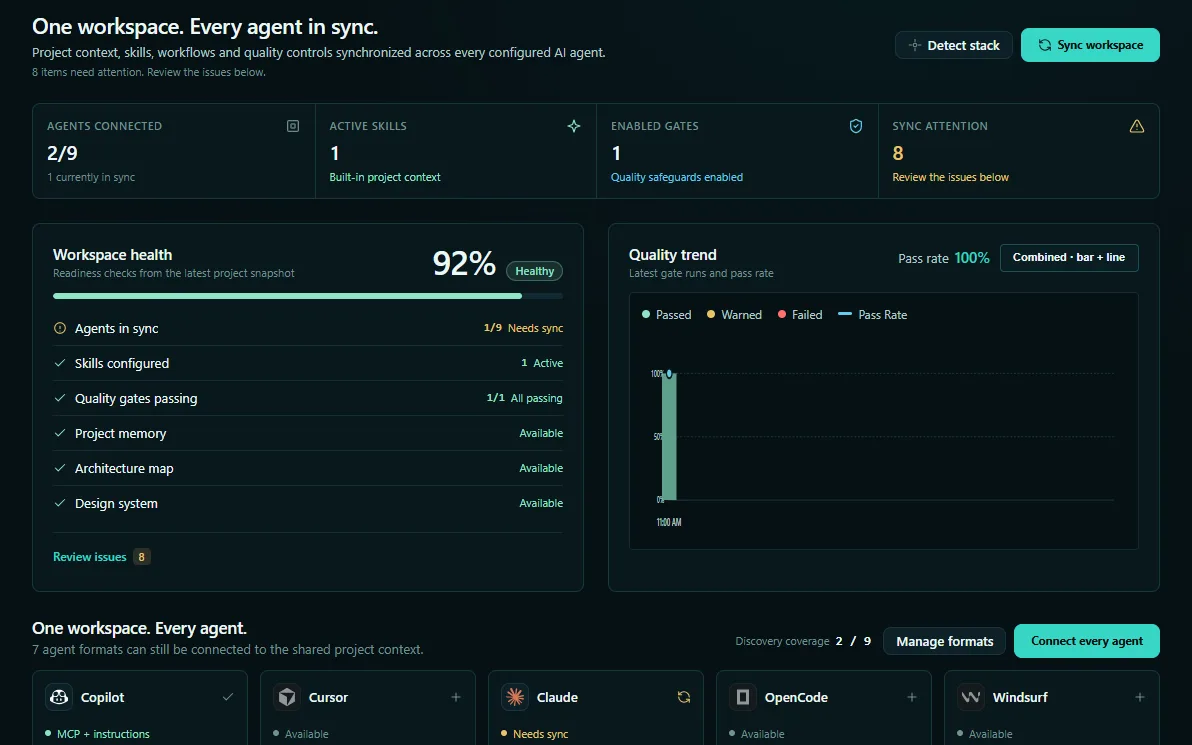
Context
Teams now work with several AI coding agents at once — Copilot, Cursor, Claude Code, Codex and others. Each one reads its own instruction format, so conventions drift between tools, between repositories and between developers.
Problem
Copy-pasted prompt files go stale, quality checks depend on whoever remembers to run them, and project knowledge lives in chat history instead of the repository.
Architecture
A monorepo with one core package that owns detection, configuration, quality gates, policies, registries and project context. The CLI, the MCP server, the local dashboard and the VS Code extension are thin surfaces over that core, so behaviour is identical wherever a developer starts.
setup detects the stack, writes native instruction files for 15 agent formats and wires up the MCP bridge. Project memory lives in a versioned .jervis/ folder next to the code.
- Surfaces
- CLIjervis-boost
- Dashboardlocal web
- VS Codeextension
- Agent bridge
- MCP serverfind_skill
- Agent sync15 formats
- Core
- Stack detection
- Quality gates
- Skill registriessigned
- Project
- Project memory.jervis/
- Policies & roles
Decisions
On-demand skills: instead of inlining every skill into each agent's instruction file, agents call a find_skill MCP tool. For a 24-skill project the generated file drops from 31.5 KB to 1.8 KB.
Private skill registries are signed with Ed25519 keys pinned outside the manifest; the signer fingerprint is recorded in the lock file and SBOM.
The dashboard runs quality gates in an isolated child process with authenticated progress and cancel endpoints, so a long gate never blocks the UI.
Outcome
Published on npm as a CLI, core engine, MCP server and dashboard, released together through changesets with CI on every release.